Mary Nikkel: A Thousand Resurrections is a reader-supported publication. To receive new posts and support my work, consider becoming a free or paid subscriber.
I lay in the first tiny, shoebox Nashville apartment I shared with my new husband. I recounted the dream in detail the next morning, a dream about being lost in Arkansas by the lake where my family used to visit my grandparents’ timeshare in thick, sluggish Augusts and Septembers in the 90s and early 2000s. I wrote:
She was wearing a worn Lion King shirt I knew so well, along with awkwardly loose black-and-white striped culottes. She wore velcro strap sandals, like her little sister. Her lanky arms and legs hung out of her clothes, and her pale skin and white-blonde hair looked smooth and unspoiled in the sunlight. Her hair had been pulled up into two pigtails — a style she favored — but the fine, straight strands were so slippery that many had fallen loose and gave her a slightly rag-tag look.
All my words and thoughts caught in one burning ball in the back of my throat. I had an overwhelming sense of the weight of all that would happen to this little girl — terrible, terrible things. I knew she would be torn apart. I knew she would be so broken. I had no feeling that I should tell her these things, but I grieved to see the contrast between who she was and who she would become. It was like seeing a pure white light shining through a window before the window becomes splattered with dirt and blood.
Mercy came down to me, their wide hazel eyes bright and inquiring beneath the riot of their hair.
“I’m trying to find my cabin,” I explained, my voice a little thick and hoarse.
They shrugged their little shoulders. “I’ll go with you.”
So we walked together. I was too afraid to hold their hand, but sometimes they’d reach out and grab my wrist to steady themself, and soon I began helping them over the rough places. We saw many cabins, but I couldn’t find where I was supposed to be staying. I began to wonder what was happening, if I’d ended up some place where a past version of my life still lived.
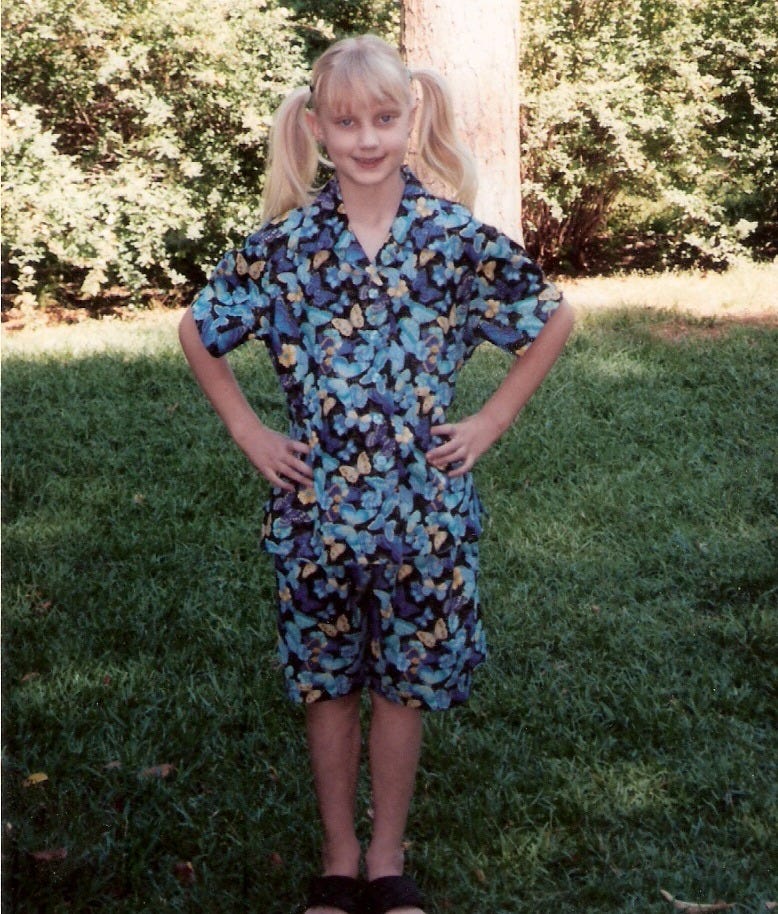
Photos from an Arkansas trip around the time I dreamed about
I followed the sweet child up a few paths, around a lake bend, over a bridge, and onto a new path. The paths we’d found before were paved with bark mulch, but this new one was fine white dust.
Mercy’s sister came flying down to meet us, her white pigtails streaming, her shoes getting steadily caked with the dust of the path. Mercy smiled and stepped aside. Mary stopped and looked at me solemnly, curious. I looked her in the face. She had those same teeth still struggling to straighten out, those overly wide and pale blue eyes, a face that managed to look soft and round with youth despite how skinny she was.
I couldn’t take it anymore. I stepped forward and swept the girl up into my arms, tall 6-year-old though she was. As if instinctively knowing this was important, she didn’t struggle or tense as I wrapped my arms around her.
“You’re never, ever going to be alone.” I was sobbing as I spoke this next to her ear, her silky pigtail against my face. “I promise. Remember that, OK? You won’t be alone. Not ever.”
Her arms held tight around my neck, her legs wrapped loosely around my waist. She didn’t seem confused or upset —simply serious, as I well knew she often was.
Still crying, I put her down. She looked up at me with those wide blue eyes.
My favorite photo from around this age, just a couple of years older
This was before therapy, for me. This was before talk about befriending your inner child saturated pop psychology. This was before I understood my own immense attachment wounding or had any formal diagnoses. This was before I would sit in endless group therapy sessions, being encouraged to “recover for your younger self.”
Somehow, I had an innate knowing that my adult self had to soften towards my child self — a child who grew into a self-punishment cycle that nearly swallowed her whole.
I have always had a profoundly hard time knowing how to make sense of the difficulty and abuse I experienced throughout my developing eras of becoming. Contrary to what some people have, I think, misconstrued, I have no interest in assigning blame or harming anyone’s reputation, which is why I don’t actually name or directly assign actions to anyone when I write about what I’ve been through.
For me, for the majority of my life, it was unthinkable that anyone other than myself could be to blame. Punishing myself became a way of sparing everyone around me, or from doing the immensely complex work of sifting through the nuance of the simple tragedy of being human beings in relationship with other human beings who are not all bad or good — just alive, wounded, and wonderful.
I had no tools for that work until quite recently. So self-harm made sense, as did starving myself, suicidal thoughts, an addiction to overwork, and a stringent asceticism that used to lead me to do things like deny myself coffee for a month or two at a time just because I felt like if there was any kind of suffering and deprivation I could think of, I should be able to endure it.
Abusive relationships shored up this story I told myself about the safety of suffering, the simplicity of its strictures. It’s easy to seek out the same dynamics that mirror your own internal landscape and sense of truth — which is exactly what I spent my 20s doing.
In September of 2025, well over a decade after I’d had the dream about making a promise to a towheaded 6-year-old self, I sat in my doctor’s office, twisting my rings around my fingers anxiously. Some wrenching circumstances where I had been harmed by people I felt unable to blame had brought trauma to the surface like a winch hoisting a shipwreck from the murk of a sunless lagoon.
On the surface, I was functional, confident, advocating for myself, and navigating my myriad appointments to keep my illnesses in check.
Underneath, I was sliding badly.
I took suicide off the table as a potential ending for myself at 16. But the thoughts linger on haunting repeat, especially as the effort of staying alive becomes beyond Herculean in this deeply unwell body.
That day in my doctor’s office, edgy as a cup of pure caffeine, I had ranked as high as you can on the PHQ-9 (the clinical ranking scale used to assess depression and suicidal ideation). Still, I assured them I had no intention of acting on my impulses. I had a flight to Germany booked for the following day, after which I’d spend a few days at a music festival with friends before traveling alone and visiting some cousins.
But the decision my doctor had to make was a hard one. Not only were my depression and suicidal ideation charting at maximum; my food intake had slipped, as it always does when I am seeking the safety of suffering. I had displayed several other major red flag behaviors.
My doctor’s office had to decide whether to send me to a psych ward — or to send me to Europe by myself, where I would have endless opportunities to dismantle myself.
I lobbied hard for the fact that rock and roll in Germany would do more to interrupt the self-punishing cycle than a psych ward ever could. Fortunately, they agreed with me. They cleared me to go.
After a whirlwind few days of plane travel, friends, jetlag, broken German, soundchecks, photography, and being deeply rooted back in the reminder of how beautiful the community 34-year-old Mary lives in truly is, I was standing beside the stage as my friends in the band Disciple played their song “After the World” acoustic to a packed-out tent.
That song is one of my two life songs, the reason why I have roses tattooed on my right forearm. As I stood there listening, I thought about being 16 and terribly alone in the world. I thought about the safety suffering provided for me in those days, days of isolation and shame, days that stole the shine of the 6-year-old from the dream. I thought about laying out knives on a bathroom counter in front of me, holding my wrists behind my head, sobbing as I sang in a small voice:
You break the glass, try to hide your face Recorded lines that just will not erase And buried in your loss of innocence You wonder if you’ll find it again
Was I there for the worst of all your pain? And was I there when your blue sky ran away? Was I there when the rains were flooding you? Off of your feet Those were My tears falling down for you, falling down for you
I’m the One that you’ve been looking for I’m the One that you’ve been waiting for I’ve had My eyes on you ever since you were born.
The song is written from the eyes of Love. Love that saw the innocent little girl, the broken 16-year-old, and suddenly — I remembered — the professional, private, traumatized, sick, but impossibly loved 34-year-old too.
The truth is that any version of me in my growing-up years could never fathom the life I live now, despite its difficulties and pain. That I bear witness to so many gorgeous souls. That I adventure so widely. That I know grace with such breathtaking nearness.
Tears stung my eyes. What are you doing, dear heart, seeking out your own sorrow? I heard a tender voice asking me. You are so loved. You are not alone. You will never, ever be alone. You are surrounded by people who love you, even here, on the other side of the world. You don’t need to hide behind your protective suffering. You know this. You have learned the better story so many times. Rest in it.
It was a holy, cathartic moment surrounded by people who reminded me of all the best things my years in music have built. I was seeing friends I hadn’t seen in years. I had been offered astonishing kindness by every single person I interacted with.
I fully believe it’s only because I was so buoyed by communal light that I was able to go on and have an experience of profound independence. I cared for myself on that trip better than I had in a long while, steadily sinking back into selfhood, into the version of myself that settles near the unbroken part of me.
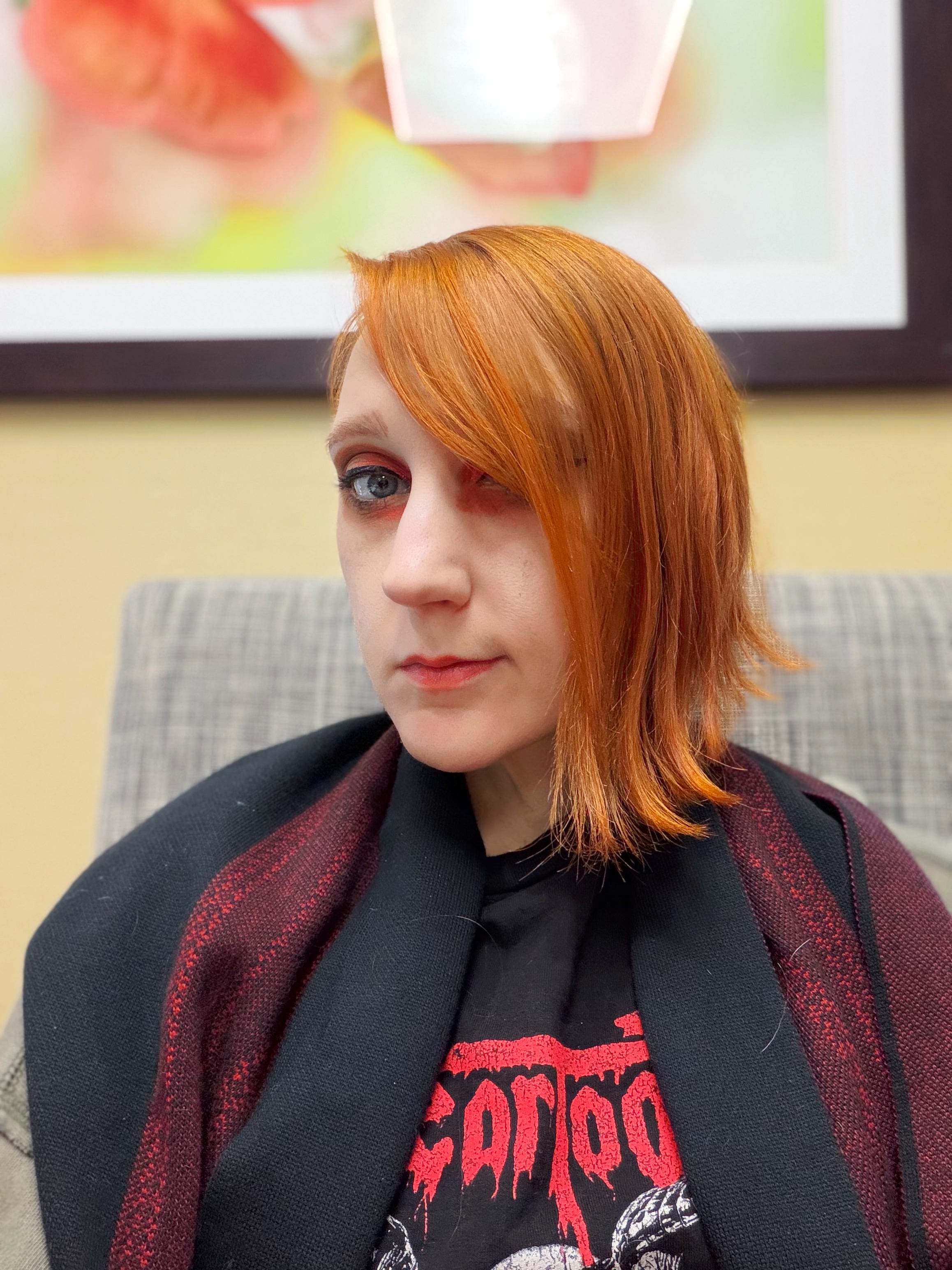
Some of my incredible friends and I in Germany. They remind me why I haven't given up on the idea of letting myself be pursued by Divine Grace.
“I tried, and near October, I thought that I could do it, but November threw us in to a whirlwind again, and come January, I knew it: all the things I told my fans about the hope that I had found are lying in a hotel bathroom, in a puddle of blood on the ground."
And someone will love it because it’s honest, and someone will hate it because it’s crude,
but as for me: for every time I give my testimony to a crowd, I'll lie awake at night and wonder about whether or not I've told the truth.
God, forgive me. I believe a lot of lies that come from the mouths of a lot of good liars, (namely: me.)”
— “Resentment” by Levi the Poet
Some life storms, there are no tornado warnings for. There is no rusted bleat on the radio. There is only the breath sucked out of the sky, the sick green air, then the five minutes that brutalize your landscape forever.
That has been my life since December.
I did not choose any of it; I would not have. But yet again, it’s been easier to blame myself. It’s been easier to pick through the pieces and find as many as possible to assign to myself as personal moral failings than it has been to even begin to process what I have lived through with some loved ones.
In January, I had yet again hit a low where my brain suggested on loop that I should take that old fire escape out of the conflagration of my retraumatized brain, conclude my own story. Tiredly, repeatedly, I said no. Instead, I packed a duffel bag and headed into the mountains for a weekend with my writer’s group, a community of women who have allowed me to bask in their creativity and their soul-full living for the past two years.
For a few days, everyone allowed me to tell the truth about what I was experiencing. I was offered absolute solidarity rather than pity. I was still treated as wholly myself, wholly welcome. In a frigid cabin that some Texan owners really probably needed to winterize, we kept each other warm with stories, with laughter, with cups of tea, with a roaring fireplace, with conversations that startled me by how effortless they felt. It was like being cocooned, for just a little while, in the same kind of radical love that I now recognize in a few special pockets in my life.
These ladies are astonishing in their skill, their kindness, their light.
I was (and am) so immensely grateful. Those were the only days of 2026 so far that did not feel like falling down the stairs in the dark.
The truth is that whether it’s my music community, my writing community (present and past), my siblings, my nieces, my countless other friends and chosen family near and far, I have so many sources of stories about myself now. Stories that don’t have to be blunted by suffering so intensely that I can salvage a painful relationship from use and abuse. Stories that reinforce the idea that some people can be safe, even in their imperfection.
Stories that give me examples of person after person walking up to that 6-year-old girl with pigtails, the girl who would suffer abuse, assault, illness, and near-death over and over again, and wrapping their arms around her to say you will never be alone.
The way Love does.
The way I still hope I can hold myself someday, too.
(For the people who have loved me this way, without demanding information, without requiring I deliver the emotional validation of a perfectly crafted response, without scaring the skittish child who still fears so often every heavy-handed approach: thank you. Thank you for being a piece of Love to me.)
Mary Nikkel: A Thousand Resurrections is a reader-supported publication. To receive new posts and support my work, consider becoming a free or paid subscriber.
I can't even begin to count the number of times I played "After the World" on my guitar while trying to wait out an urge to self-harm. I'm always moved by your words. Thank you for sharing something so personal with us.




I can't even begin to count the number of times I played "After the World" on my guitar while trying to wait out an urge to self-harm. I'm always moved by your words. Thank you for sharing something so personal with us.